


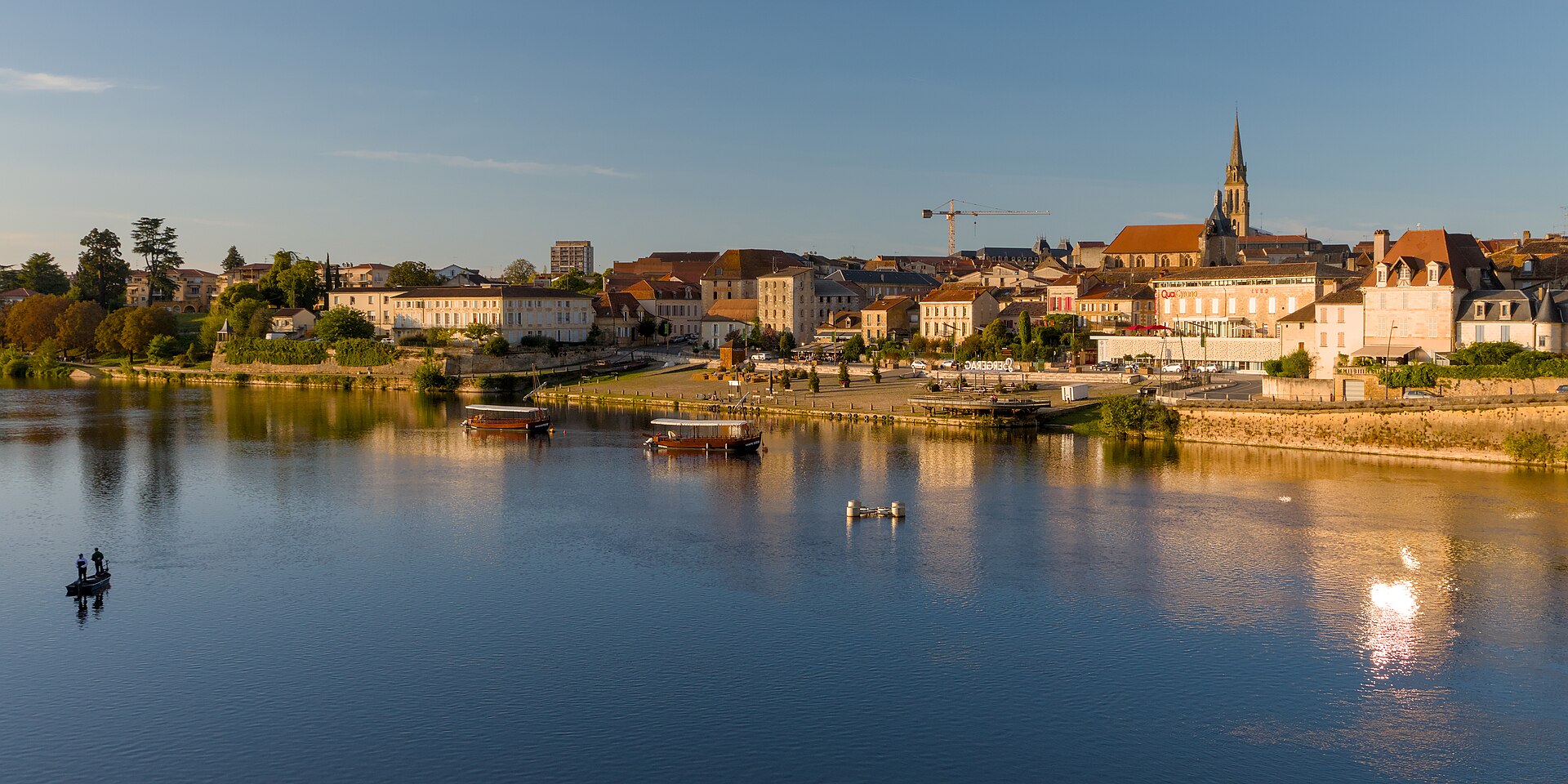
Photo: Benjamin Smith, CC BY-SA 4.0, via Wikimedia Commons
Bergerac France sits on the banks of the river Dordogne, roughly 22.3 km from the tower as the crow flies, though the road takes you about a third further than that. It is a subprefecture of the Dordogne department and the second most populated commune in the department after Périgueux. In 2013 the Ministry of Culture named it a Town of Art and History.
A town with a treaty and a resistance history
Charles IX passed through Bergerac in 1565 during his grand tour of the kingdom, and in 1577, in the middle of the French Wars of Religion, the town gave its name to a peace agreement. The Treaty of Bergerac was signed on 17 September that year between Henri III and the Protestant side, negotiated by figures including Nicolas de Neufville, seigneur de Villeroy, and Armand de Gontaut, baron de Biron, for the king, and François de la Noue and François, Duke of Montpensier, for the Protestants. It bought a temporary end to the fighting. The town’s Hôtel de Ville was completed around 1795. Later, during the Second World War, Bergerac was a place where members of the Dordogne Resistance were held and interrogated by the occupying forces. The town was freed on 21 August 1944.
The old town and the river port
Bergerac grew up on the Dordogne, and the old port quarter is still the part worth slowing down for. The church of Notre Dame stands in the town centre. There is a town museum, a statue museum and a tobacco museum, reflecting the two trades that shaped the local economy for generations. Down by the river there is a wine house with an exhibition on the history of wine growing in the area, which is a useful stop if you want the background before tasting anything. The Dordogne itself is part of the appeal here: river boat tours run from the town, and kayaks can be hired for those who would rather be on the water than looking at it.
Bergerac sits within the Périgord Pourpre, one of the four traditionally named colours of the region. If you want to understand how that fits with the Périgord Noir around Sarlat or the Périgord Vert further north, our piece on the four Périgords, Noir, Blanc, Vert and Pourpre, lays it out.
Two statues of Cyrano
The town’s most quoted association is with Cyrano de Bergerac, subject of a famous play by Edmond Rostand. Bergerac has two statues of him. An older stone one stands on Place de la Myrpe, facing Place du Docteur Cayla, in the heart of the old town. A newer statue, painted in colour and set on a stainless steel pedestal, stands on Place Pélissière. The two make a decent short walk on their own, and both squares are worth lingering in regardless.
Wine, tobacco and the twelve AOCs
The Bergerac region is known above all for wine and tobacco, and the wine side of that is formalised in twelve recognised appellations d’origine contrôlée: Bergerac, Bergerac Rosé, Bergerac Sec, Côtes-de-Bergerac, Côtes de Bergerac Blanc, Côtes de Montravel, Montravel, Haut-Montravel, Saussignac, Monbazillac, Pécharmant and Rosette. That is a wide spread for one small area, from dry whites to the sweet wines of Monbazillac, whose château is a well known stop for visitors and sits close to the town. Wine tours and château visits are a normal part of a trip here, alongside the Arboretum de Podestat for anyone who wants a quieter, greener stop.
Getting there from the tower
From the tower, Bergerac is about 22.3 km away in a straight line, and closer to 30 km by road, so it makes a comfortable half day or a longer day out combined with a vineyard visit. Bergerac also has its own SNCF station, with regular services to Bordeaux and to Sarlat-la-Canéda, useful if anyone in your party would rather arrive by train. There is an airport, Bergerac-Roumanière, with flights to a good number of UK airports as well as to Amsterdam and Rotterdam, which is worth knowing if friends are flying out to join you rather than driving down. A weekday bus service also links Bergerac with Périgueux, though it is aimed mainly at commuters rather than day trippers.
A few practical notes
Bergerac has a sizeable British population, part of a wider pattern across the Dordogne, and there are local initiatives such as the Université du Temps Libre that run French classes and cultural activities partly aimed at newer arrivals. Museum opening times, wine house hours and boat trip schedules change with the season, so it is worth checking directly with the site itself before you plan a day around any one of them. If you are combining Bergerac with other stops, our guide to the region covers how it fits alongside the rest of the Dordogne, and our piece on the bastide towns of the Dordogne is worth a look if you want to add a planned medieval grid town to the same trip.
Good to know
How far is Bergerac from the tower?
About 22.3 km in a straight line. By road it is roughly a third further, so allow for that when planning a day out.
What is Bergerac best known for?
It is a river town on the Dordogne known for wine, with twelve local AOCs, and for tobacco growing. It also has two statues of Cyrano de Bergerac and an old port quarter recognised as a Town of Art and History.
Can you get to Bergerac by train or plane?
Yes. Bergerac has an SNCF station with services to Bordeaux and Sarlat-la-Canéda, and Bergerac-Roumanière airport has flights to a number of UK airports as well as to Amsterdam and Rotterdam.
Sources
More about the region
Bastide Towns of the Dordogne: Medieval New Towns on a Grid
Long before anyone called this region picturesque, its lords were laying out new towns on a grid, with…
The Four Périgords: Noir, Blanc, Vert and Pourpre Explained
Périgord is not one place but four, each with its own colour, its own soil and its own…