


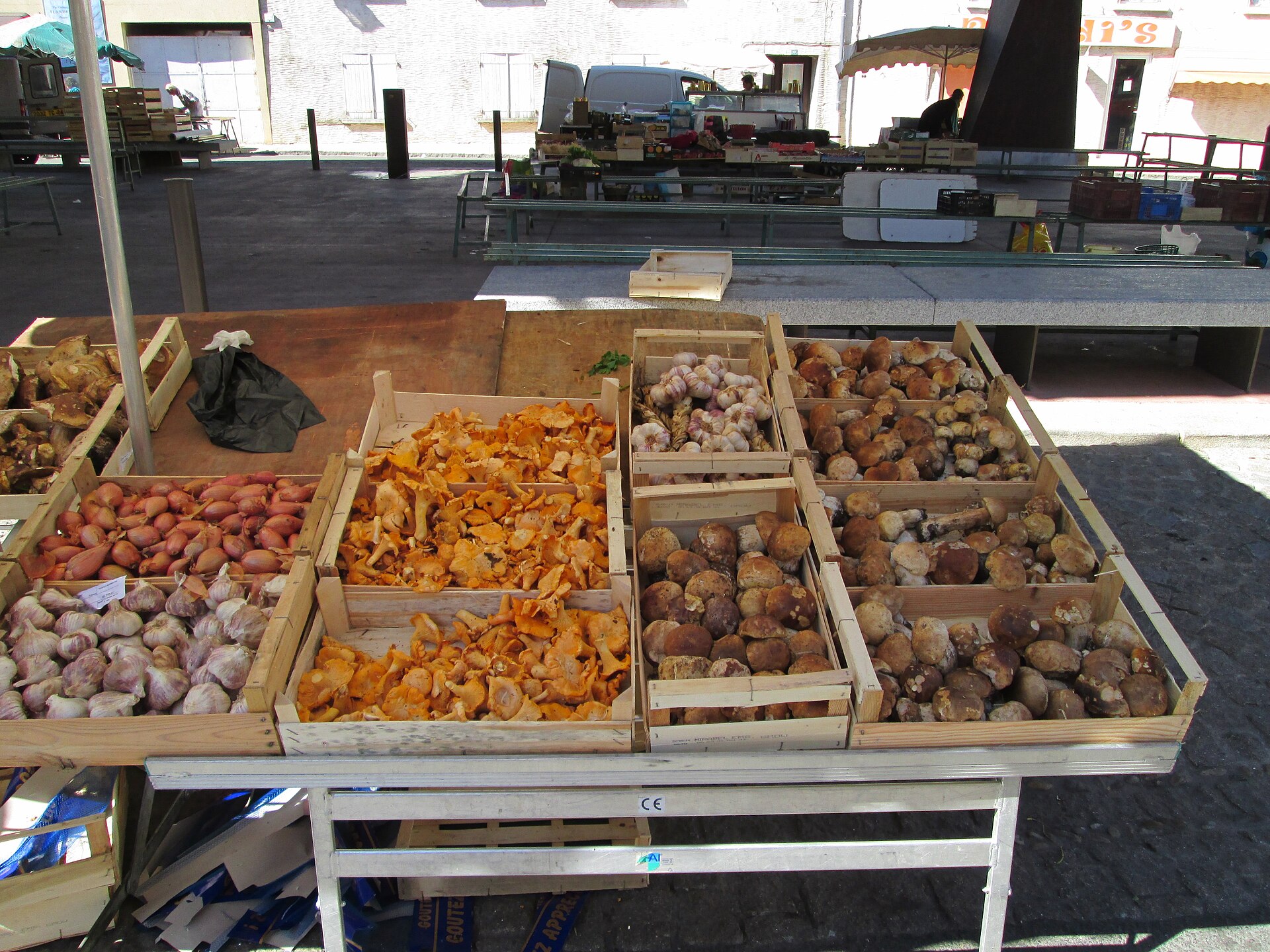
Photo: Cjp24, CC BY-SA 4.0, via Wikimedia Commons
Dordogne markets are one of the best reasons to plan a day around a town rather than a single sight. If you are staying with us, you have a genuine choice: Issigeac, Périgueux, Bergerac and Sarlat are all within reach by car, each with its own character. This piece sets out how a French market actually works, what the different kinds mean for what ends up on the stall, and which of the local towns suits which sort of day.
Long before France, or the Dordogne, existed
Markets are about as old as trade itself. Open-air markets were part of daily life in ancient Babylonia, Assyria, Phoenicia, Greece, Egypt and the Arabian peninsula, and documentary evidence suggests a form of bazaar was already operating in the Middle East by around 3000 BCE, with long lines of stalls under a covered roof to keep off the sun. In ancient Greece, trade was organised around the agora, the city’s open central space, with stallholders grouped by trade: fish in one place, clothing in another, and higher value goods such as perfume kept apart. Officials in Athens were specifically employed to oversee weights, measures and coinage, so that buyers were not cheated. Rome traded through its forums, and at Pompeii, a town of around 12,000 people, produce was sold near the Forum while livestock was kept out at the edge of town near the amphitheatre. Stallholders there paid a market tax for the right to trade, and a piece of surviving graffiti lists a whole seven-day cycle of markets rotating between nearby towns. None of this happened anywhere near the Périgord, but it is worth knowing how old, and how carefully regulated, the whole idea of a market square already was.
How markets multiplied across medieval Europe
The word market comes from the Latin mercatus. The earliest recorded use of the English word appears in the Anglo-Saxon Chronicle of 963, written in the reign of Alfred the Great: Ic wille þæt markete beo in þe selue tun, meaning I desire that there be a market in the same town. From the twelfth century, monarchs and lords began granting charters allowing a particular town to hold a market on set days, in exchange for an annual fee, and once a charter was granted, no rival market nearby could open on the same days. Fairs, usually held once a year and tied to a religious festival, traded in higher value goods and came with entertainment: dance, music, tournaments. Ordinary markets, held weekly or twice weekly, dealt in the everyday: fresh produce and necessities. As charters multiplied, market towns spaced themselves out deliberately, close enough that a farmer could get to market and home again within a day, roughly ten kilometres, but far enough apart to avoid competing head on for the same trade. In England alone, around 2,000 new markets were founded between 1200 and 1349, and by 1516 the country had 2,464 markets and 2,767 fairs. Alongside all this, regulation of weights, measures and the quality of goods sold increased steadily, precisely because regulation is what gave shoppers confidence they were being dealt with fairly. That confidence is still the whole point of a market, wherever it is held.
What you are actually buying at a French market
In France, the classic market grew out of exactly this need: a place to sell what a garden, an orchard, a smallholding or a workshop produced in quantities too small or too irregular to interest national trade. Selling directly, without heavy packaging, transport or a middleman, meant a fairer return for the grower or maker and a better price for the shopper. That is still the idea behind a Dordogne market stall piled with walnuts, plums, cheese or a farmhouse pâté. It is worth knowing, though, that the same free trade which lets a local producer sell alongside everyone else also lets a stallholder resell goods bought in from elsewhere, including from abroad. A market square is open to anyone licensed to trade there, not only to the people who actually grew what is on the table. If knowing exactly where your lunch came from matters to you, it is worth asking the seller directly. Our guide to eating in the Périgord goes further into what you will actually find on the stalls and on the plate.
Producer-only markets, and why they exist
Some French farmers, unhappy at seeing imported produce sold alongside their own, have set up markets that exclude resellers altogether: a marché de producteurs, open only to the people who grew, reared or made what they are selling. The idea has a strong political history in France. One of the best known producer-only markets, in the hamlet of Montredon on the Larzac plateau, grew directly out of the Larzac farmers’ movement and the opposition to the World Trade Organisation, launched in 1988 by an association of farmers and supporters that included Joseph Bové. You will not find that particular market in the Dordogne, but the same principle, a stall run by the person who grew what is on it, is exactly what to look for if that is what you want from a morning out: look for a producteur sign, or simply ask.
The auction market, for context
Not every French market works by browsing and haggling. A marché à la criée is an auction market, most often for fish or other perishable produce, where a chef de vente, once called a crieur, calls a starting price per kilogram. In a marché au cadran, the price descends until a buyer signals interest and takes the lot, with a floor price built in so it cannot fall too low. You are unlikely to meet this on a Dordogne town square, it belongs more to ports and wholesale halls, but it is part of the same broad tradition of regulated public trading that shaped every market described here.
Which Dordogne town to choose from the tower
Guests at the tower arrive by car and often build day trips around the towns of the Dordogne, sometimes crossing into the neighbouring Lot as well. Here is what each of the main options actually offers.
Issigeac, for a market morning
Issigeac is a small medieval village built on a circular plan around its church and its seventeenth-century Bishop’s Palace, still ringed in part by thirteenth-century walls and lined with half-timbered houses. It sits in Bergerac wine country, about 20 km southeast of Bergerac itself. Its Sunday morning market offers gastronomic products, local wines, meat, fruit and vegetables, brought to market directly by the people who produce them. It is a good choice if the shopping itself is the point of the day, with the village’s own medieval streets as a bonus.
Périgueux, for a day in the city
Périgueux is the prefecture of the Dordogne department and was, historically, the capital of the Périgord. It is also the seat of a Roman Catholic diocese, which gives some sense of how long it has been the region’s principal town. It lies around 20 km north of the tower in a straight line. As the largest town within easy reach, it is worth considering if you want a proper day in a city, with time to explore its streets and history.
Bergerac, on the river
Bergerac is the Dordogne’s subprefecture and its second most populous commune after Périgueux, sitting on the banks of the river Dordogne about 22 km south-west of the tower. It was designated a Town of Art and History by the Ministry of Culture in 2013, and its riverside streets reward a wander. It is worth checking with the town’s own tourist office for any market days, since these can change.
Sarlat, for a longer day out
Sarlat-la-Canéda, usually just called Sarlat, is the main tourist draw of the Périgord Noir and the furthest of these four from the tower, around 46 km east. It only became a single commune in 1965, when the separate towns of Sarlat and La Canéda were merged. That distance makes it more of a full day than a quick trip, with plenty of sightseeing to justify the drive.
Planning the day
Because market days vary between towns, and can change, it is worth checking with the town’s own tourist office before you set off, rather than relying on anything printed. Beyond that, the main planning question is simply how far you want to drive: Vergt, the nearest town to the tower at around 5 km, is the closest thing to an everyday shopping trip, while Issigeac, Périgueux and Bergerac all sit within a short drive, and Sarlat is worth setting aside a full day for. Our guide to the region has more on planning day trips out from the tower, including the occasional run over the departmental boundary into the Lot. And if you have not yet seen where you would be staying while you plan all this, there is more on the tower itself.
None of this is complicated once you have done it once: turn up, look at what is actually on the stall rather than what is printed on a sign, and ask the seller directly if you want to know where something came from. It is, after all, exactly the same question shoppers have been asking at markets for as long as markets have existed.
Good to know
What is the difference between a classic market and a marché de producteurs?
A classic French market is open to anyone licensed to trade there, so local growers sell alongside stallholders reselling goods from further afield. A marché de producteurs excludes resellers altogether: everyone selling is the person who grew, reared or made what is on the stall.
Does Issigeac hold a market?
Yes. Issigeac holds a market on Sunday mornings with local wine, meat, fruit and vegetables sold directly by producers. For markets in Périgueux, Bergerac or Sarlat, it is worth checking with the local tourist office before planning a trip around one.
Which Dordogne town is closest to the tower?
Vergt, the nearest town at around 5 km, is handy for everyday shopping. Issigeac, Périgueux and Bergerac are all a short drive away, while Sarlat, at around 46 km, is better treated as a full day out.
Sources
More about the region
Périgord Food: A Complete Guide to the Region’s Specialities
Périgord food means duck, goose, walnuts and truffles long before it means anything fashionable. Here is what those…