


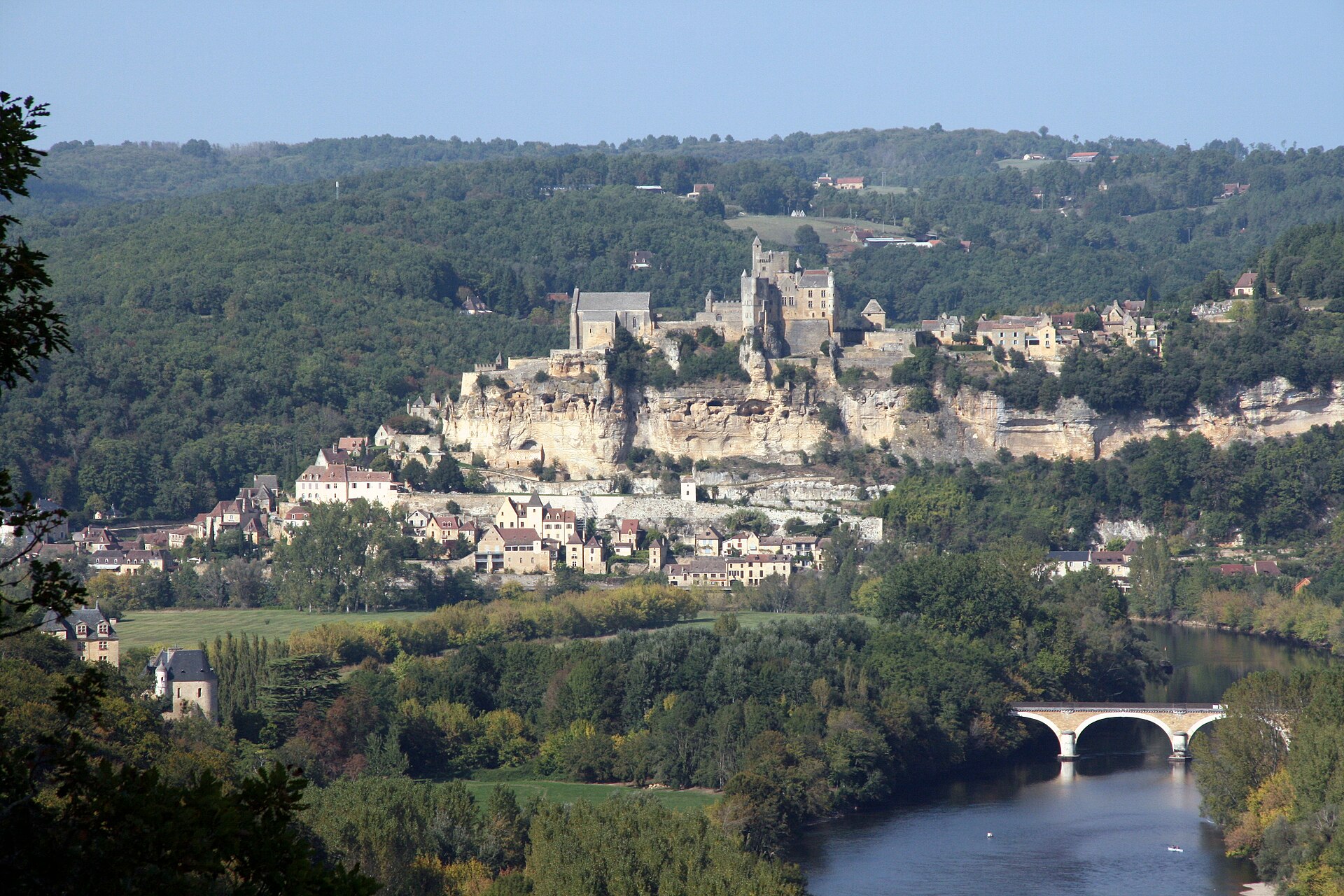
Photo: Sémhur, CC BY-SA 4.0, via Wikimedia Commons
Château de Beynac sits on top of a limestone cliff above the north bank of the Dordogne, in the commune of Beynac-et-Cazenac. It is one of the best preserved and best known castles in the region, and one of the more distant days out from the tower: about 43 km away as the crow flies, though the drive along the river roads runs closer to a third further than that.
If you are working out which castles to fit into a week here, our guide to the castles of the Dordogne sets Beynac alongside the other main houses of the region, and our guide to the region covers how it fits with a day that takes in Sarlat or the river villages.
A valley closed by stone
The castle was built in the 12th century by the barons of Beynac, holders of one of the four baronies of Périgord, to close off the valley below. The cliff face itself was steep enough to discourage any attack from the river side, so the barons put their effort into the plateau side instead: a double line of crenellated walls, a double moat (one section of which deepens a natural ravine), and a double barbican guarding the approach. It is a castle built for one direction of attack and left alone on the other.
Inside the walls
The oldest part of the château is a large square Romanesque keep, plain and vertical, with few openings and a narrow spiral staircase climbing to a crenellated terrace. A residence of the same period is attached to one side, later remodelled and enlarged in the 16th and 17th centuries. On the other side stands a partly 14th-century residence, with a courtyard and a square staircase serving apartments from the 17th century. Those apartments still have their original woodwork and a painted ceiling from the same period.
The Salle des États has a sculpted Renaissance fireplace and opens onto a small oratory covered entirely in 15th-century frescoes, among them a Pietà, a Saint Christopher and a Last Supper in which Saint Martial, first bishop of Limoges, appears as the maître d’hôtel. Visitors can also see tapestries depicting hunting scenes and other episodes from the daily life of the lords who held the castle. If you want a clearer sense of how a fortress like this differs from the smaller manor houses of the area, our piece on reading a Périgord castle is worth a look before you go.
A border in stone
For a period the barony passed out of the Beynac family entirely: Richard the Lionheart, king of England, held it between 1189 and 1199, one line in a long list of barons that runs from the 12th century to the 18th. It returned to French hands afterwards, and by the time of the Hundred Years’ War, Beynac stood firmly on the French side of a river that had become the border itself. Directly across the water, Château de Castelnaud was held by the English. The two castles faced each other for years, but in practice these places changed hands more often through negotiation and intrigue than through direct assault: the armies needed to take a fortress like this were so costly that only the wealthiest lords and kings could afford to build, hold or besiege one.
From private house to national monument
The Beynac family held the castle for centuries, but died out in the male line in 1753 with Pierre, the last marquis. His two daughters married into other families, and the château passed by marriage to the Beaumont du Repaire family, who added Beynac to their own name. The castle has been classified as a monument historique since 1944. It was bought in 1962 by Lucien Grosso, who took on its restoration and brought the building back into use.
On screen
Beynac’s silhouette has made it a favourite with film crews for decades. It has appeared in Le Capitan (1960), the television mini-series Gaston Phébus (1978), Elle voit des nains partout! (1982), Les Visiteurs (1993), La Fille de d’Artagnan (1994), Les Couloirs du temps: Les Visiteurs 2 (1997), Ever After (1998), Luc Besson’s Jeanne d’Arc (1999), Chocolat (2000, with scenes shot in the village below), Fanfan la Tulipe (2003) and Ridley Scott’s The Last Duel (2021). It is worth remembering, looking up at the keep, how many different centuries have been filmed against the same stone.
Planning the visit
Opening times and admission arrangements change from year to year, so it is worth checking the château’s own site before you set off rather than relying on anything printed here. Castelnaud, on the opposite bank, shares much of Beynac’s history and stands within sight of it, which makes it worth considering alongside a visit here. For the practical details of where you will be starting from, see the page about the tower itself.
Good to know
How far is Château de Beynac from the tower?
About 43 km in a straight line. The road distance is roughly a third further, following the river valleys.
Can you see Château de Castelnaud from Château de Beynac?
Yes. The two castles face each other across the Dordogne, and during the Hundred Years’ War one was held by the French and the other by the English.
Has Château de Beynac appeared in any well-known films?
Several, including Les Visiteurs, Jeanne d’Arc, Chocolat and Ridley Scott’s The Last Duel, along with earlier films going back to 1960.
Sources
More about the region
Château, Manoir or Maison Forte? How to Read a Périgord Castle
Château, manoir and maison forte are not interchangeable decorations on a road sign, they describe different kinds of…
Dordogne Castles: A Guide to Which Ones Are Worth Your Day
The Périgord has a long history of medieval castles and Renaissance chateaux. Here is what the history books…