


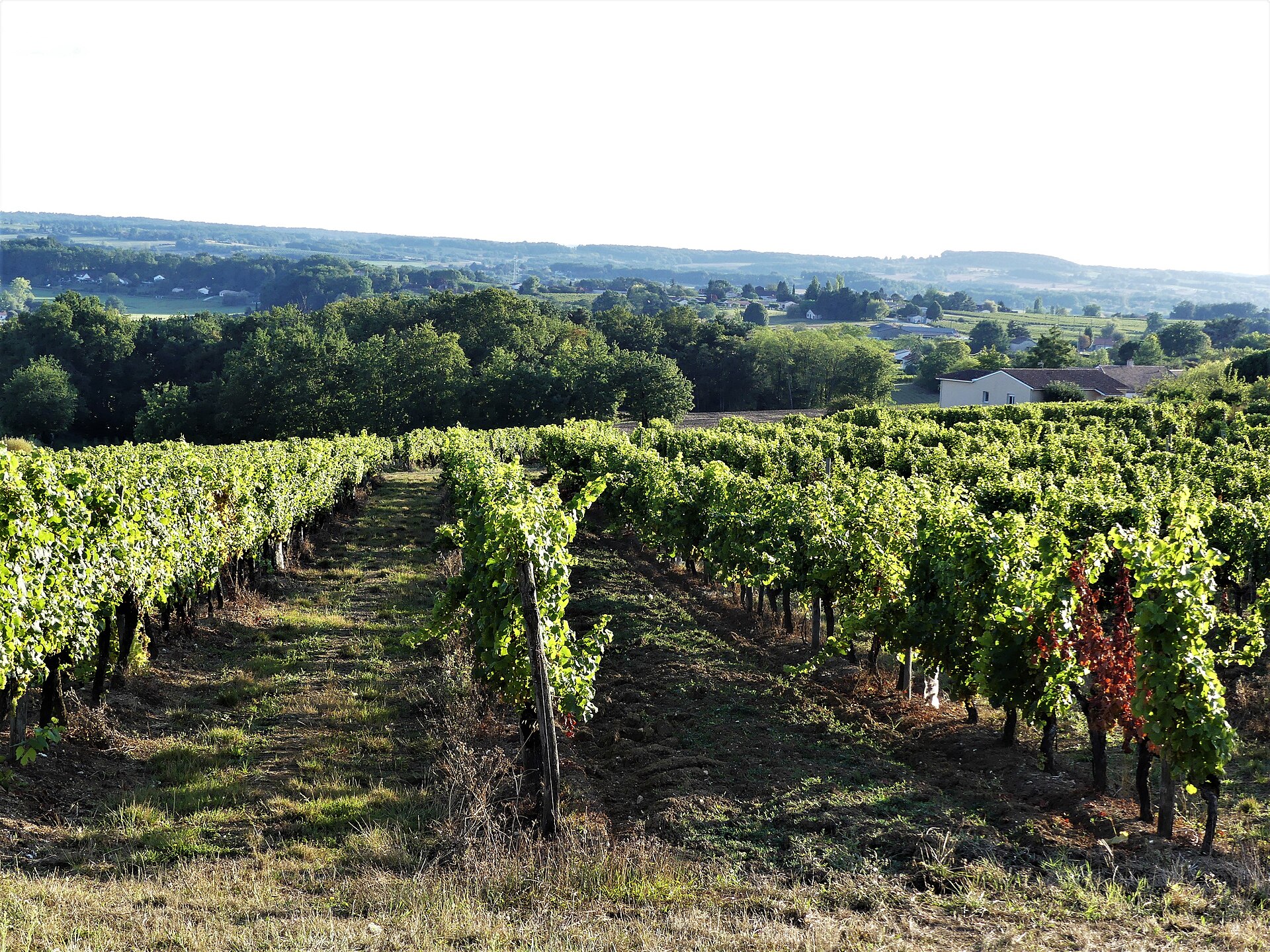
Photo: Père Igor, CC BY-SA 4.0, via Wikimedia Commons
Bergerac wine is the name given to the whole wine-growing area around the town of Bergerac, in the Dordogne department of South West France. It is a subregion in its own right, sitting immediately east of the Bordeaux wine region, and it covers 93 communes across roughly 12,000 hectares of vines. About 1,200 wine-growers work this land, and between them they produce red, white and rosé wine under thirteen separate Appellations d’origin contrôlées (AOCs). Most of it is drunk in France, but around fifteen per cent is exported, mainly to Great Britain, Belgium, Germany and the Netherlands.
For anyone staying at the tower, this is wine country on the doorstep rather than a day trip. The vineyards run through the same low hills and river terraces you can see from our guide to the region, and a short drive in almost any direction brings you to one appellation or another.
What Bergerac wine actually means
The boundaries of the Bergerac wine region correspond more or less to the arrondissement of Bergerac. Within that single area sit thirteen AOCs, some covering the whole zone, others much smaller and tied to a particular village or hillside. The broad Bergerac AOC itself is produced across 87 of those communes, on the southern side of the Dordogne department, and shares its production area with the stricter Côtes de Bergerac appellation. Nested inside this large zone are the more restrictive local appellations: Monbazillac, Montravel, Côtes de Montravel, Haut-Montravel, Pécharmant, Rosette and Saussignac. Each has its own rules on yield, sugar content and grape mix, which is why a Bergerac label can mean a light, early-drinking red one week and a rich dessert wine the next.
The name Bergerac itself is thought to come from the Occitan for a high fort or stronghold, probably combining the Latin burgus (fort) with acutus (sharp or high), a reasonable description of a town built on a hill above the river.
A history longer than Bordeaux’s
Vines were planted here under the Romans, in what was then a newly settled district, and the Dordogne river quickly became the route to market. The Visigoths who took over after Rome’s fall kept the vineyards going, being keen drinkers themselves, but the arrival of the Saracens brought an order to uproot the vines, and the Viking raids that followed pushed communities inward and cut off trade for a time.
Bergerac had recovered enough by the thirteenth century to be producing wine seriously, and in 1254 it began shipping vintages to England under privileges granted by Henry III, including tax exemptions and the right to send wine down to Bordeaux unhindered. By the fourteenth century the growing areas had defined quality standards of their own. That did not stop Bordeaux, sitting closer to the Atlantic on the Garonne, from giving its own barrels priority over Bergerac’s on the river barges. It took until 1511 for the Parlement of Guyenne to grant Bergerac a charter allowing it to ship wine freely to the coast, by which point the largely Protestant town was also trading overland with Holland and Scandinavia.
The Wars of Religion pushed many of Bergerac’s Protestant merchants into exile, particularly to Holland, and their loyalty to home-grown wine kept demand alive abroad. Growers responded by leaning into dry whites and sweet dessert wines, the styles their exiled customers wanted, a shift that still shapes the region’s whites today.
The modern identity crisis came in the twentieth century, when the Bordeaux appellation’s boundaries were redrawn to match the Gironde department exactly, cutting Bergerac out overnight. Wines that had been sold for generations under the Bordeaux name suddenly needed a new one, and the Libourne merchants who had handled the trade put their own Bordeaux-labelled stock first, leaving Bergerac to build a separate market from scratch.
Soil: why the map of styles follows the map of rock
The variety of wine styles across the region tracks the variety of soil almost exactly. In the south east, old lake-bed limestone produces brown soil scattered with calcareous pebbles, of varying depth depending on the lie of the land. North of the Dordogne, the bedrock is sand and clay mixed with gravel, giving acidic, faded brown soils, with minerals collecting deep down to form a hard, impermeable layer known locally as tran. Also in the south east, sandy, washed-out silts called boulbènes form a crusted, nutrient-poor soil. To the west, marine limestone gives the same brown, pebbly soil found across the border in Saint-Émilion, Côtes de Castillon and Côtes de Franc.
Running along both banks of the river, terraces of gravel laid down by the Dordogne during the Quaternary period add a further layer: acidic, not especially fertile, but very well drained, which matters more than fertility for a vine.
Climate: a growing season built for both dry whites and sweet ones
Bergerac has a temperate oceanic climate, with around 116 days of rainfall a year against 196 days of fine weather, split between milder and stronger sunshine. April tends to be humid, which pushes the vines into growth and, usefully, helps stave off spring frost. Summers are warm and comparatively dry, good conditions for ripening, and from May to August the area gets more than 200 hours of sunshine a month, the fuel the vine needs for photosynthesis.
September and October decide the character of the vintage. A dry September concentrates aroma in the grape, while a moderately humid October encourages noble rot, the fungus that shrivels grapes and concentrates sugar, essential for the region’s sweet wines. Rain returns in November and December to recharge the soil’s water reserves ahead of the next season.
The grapes behind the wine
Red Bergerac wines are blends, built mainly on Cabernet Sauvignon, Cabernet Franc and Merlot, sometimes with Côt added and occasionally a little Fer Servadou or Mérille. The results tend to be dark in colour and full-bodied.
White wines lean on Sémillon alongside Sauvignon Blanc, Sauvignon Gris and Muscadelle, with Ugni Blanc, Ondenc or Chenin Blanc sometimes joining the blend. The same broad palette of grapes produces both powerful dry whites and the aromatic medium-sweet or sweet wines the region is known for, depending on how and when the grapes are picked.
The appellations, one by one
Thirteen AOCs sit within the Bergerac wine region, though several are small enough that most drinkers outside France will never have seen the label. Here is what each one is for.
Bergerac AOC
The broad, everyday appellation, covering dry white, rosé and red wine across the whole southern part of the department. These are wines meant to be opened young, from around two years old, rather than laid down.
Côtes de Bergerac AOC
Sharing its production area with the Bergerac AOC but held to stricter conditions, this appellation produces mellow, soft reds that need time in the cellar to show their best.
Montravel AOC
Dry white wines and reds, produced in the western part of the region towards the Bordeaux border.
Haut-Montravel AOC and Côtes de Montravel AOC
Two related appellations, both given over entirely to sweet white wine, produced within the wider Montravel area.
Monbazillac AOC
The best known of the sweet wines, made in the village of Monbazillac on the left bank of the Dordogne, directly across the river from the town of Bergerac. The appellation covers almost 2,000 hectares and produces white dessert wine built to be stored for a long time.
Pécharmant AOC
A red-only appellation from the hills north east of Bergerac, across the communes of Bergerac, Creysse and Lembras, with around 400 hectares under vine. It has held AOC status since 1936 and is generally regarded as the best-known Dordogne wine name after Monbazillac, producing reds suited to medium-term storage.
Rosette AOC
The smallest appellation in the whole region, and correspondingly little known outside it. It produces white wines ranging from medium-sweet to sweet.
Saussignac AOC
Centred on the village of Saussignac, in the canton of Sigoulès, this appellation makes white dessert wine intended for medium to long storage. Saussignac itself sits at the heart of Bergerac wine country, and the smaller communes around it each produce their own wine as well.
Planning a visit from the tower
Because the appellations sit so close together, it is easy to build a short itinerary that takes in more than one style of Bergerac wine without covering much distance. The region also lies within reach of the painted, engraved and dripstone caves of the Dordogne, for those who want to split a trip between vines and rock. Whatever the itinerary, it is worth checking opening arrangements directly with any cellar or cave before setting out, as these change from year to year.
Good to know
What kind of wine is Bergerac known for?
Bergerac produces red, white and rosé wine, ranging from everyday dry styles under the broad Bergerac AOC to well-known sweet dessert wines such as Monbazillac and Saussignac, and structured reds from Pécharmant.
How many appellations does the Bergerac wine region have?
Thirteen AOCs sit within the region, including the broad Bergerac and Côtes de Bergerac appellations and smaller, more local ones such as Monbazillac, Pécharmant, Montravel, Rosette and Saussignac.
Is Bergerac wine the same as Bordeaux?
No. Bergerac lies immediately east of the Bordeaux region and shares some grape varieties and history, but it has been a separate wine region with its own appellations since the early twentieth century, when Bordeaux’s boundaries were redrawn to exclude it.
Sources
More about the region
Visiting Dordogne Wineries: Cellar Doors, Tastings and Etiquette
Bergerac wine country begins a short drive from the tower, with thirteen appellations covering reds, dry whites and…